Blogs

Mission (I'm) Possible: Unmasking the Invisible Barriers
December 7, 2025
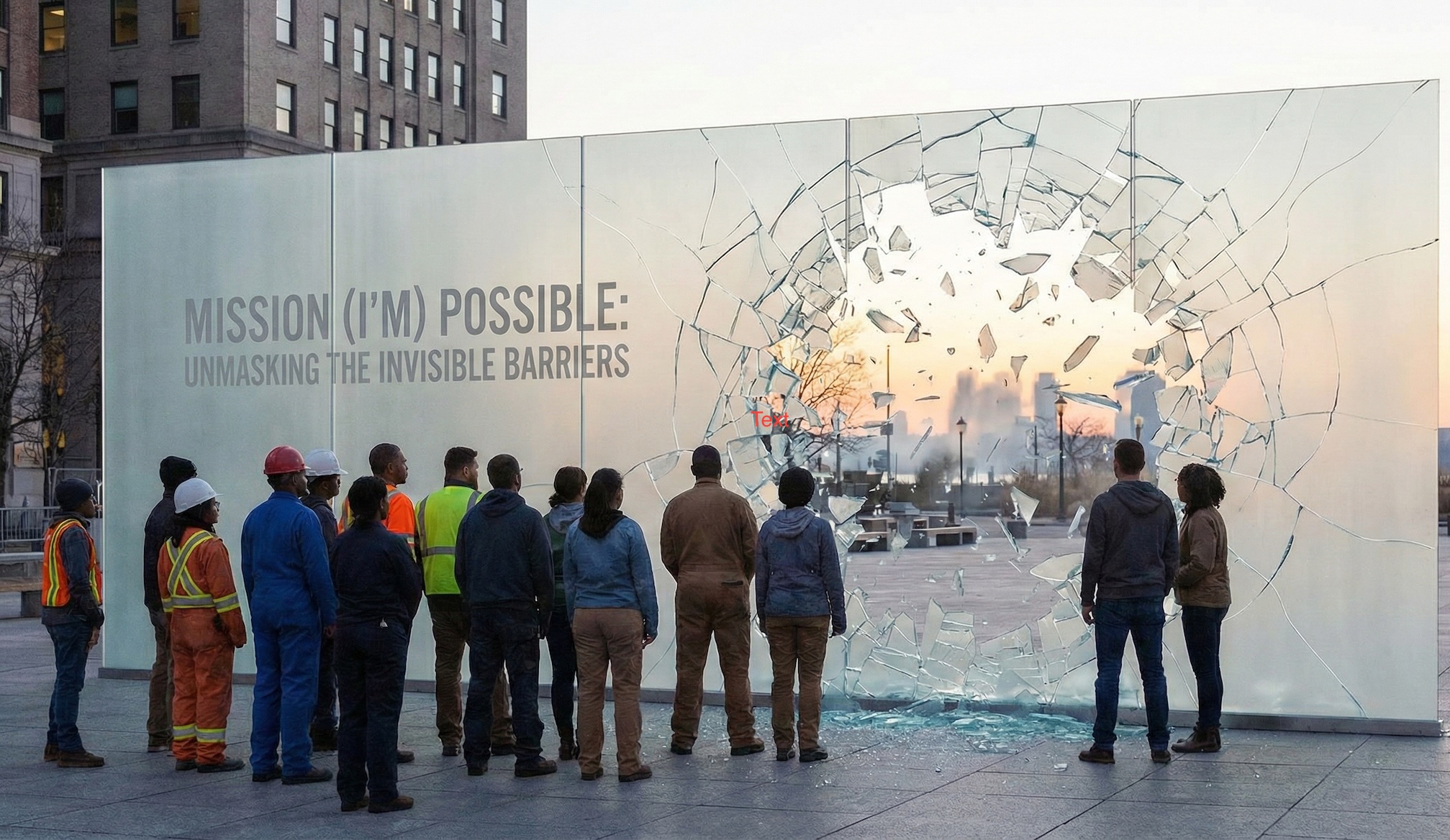
This blog post provides a sneak peek into the highly acclaimed book, Getting to Better, (de Groot, 2026). The article, which is captured in Chapter 7 of the book, explores how subtle misunderstandings often take root in our beliefs and language, convincing us that certain situations are utterly impossible. This chapter explores these invisible barriers, revealing their unintended consequences so we can redefine our approaches and realign them in line with the true needs and potential of the humans we're committed to helping.
Our Beliefs Shape Our Language.
Our Language Determines Our Reality.
How Language Creates Reality
If I had a dime for every time I heard someone declare that trying to change another person's attitude or behavior was a waste of time and effort, I would have a significant fortune. For approximately 15 years, my primary role involved consulting on or supporting some of the most challenging human situations imaginable. These weren't just difficult cases; they often involved individuals who were reluctant, uncooperative, resistant to help, or even outright oppositional and violent towards formal interventions.
I worked with thousands of parents, teachers, professional helpers, and leaders across various fields. In countless conversations and consultations, one phrase echoed relentlessly: "This isn't going to change," or "They aren't going to change." This was almost invariably followed by the definitive conclusion: "It's impossible." Other words that commonly peppered these discussions, reinforcing this shared perspective, were the words "can't," "won't," "never," and "always."
A series of complaints often represented our conversations, totally riddled with these limiting terms. It was not uncommon to hear statements like:
- "This student will never attend class."
- "That surgeon won't stop belittling and scaring the nurses."
- "The underground miner can't be kind or civil in staff meetings."
- "The CEO will always deny funding for leadership training."
- "These inmates will never cooperate with programming."
- "These kinds of kids will always run away."
- "You won't get the executive team to focus on strengths."
- "That teacher will never give second chances."
- "Her mother won't ever take her to a doctor's office."
- "That F-35 pilot will never admit he's afraid to fly alone".
And quite often, you could hear the full catalogue of limiting words in a single breath: "You know Kyle is always manipulating us - he won't change. He never listens and has always been this way. Just read the file information. He can't change. We've tried everything. It's impossible."
I'm not sure about you but even reading this now and reflecting on so many of these past situations, I feel negative, stressed, and overwhelmed. This kind of language doesn't just describe reality, it actually creates a certain type of reality - one that breeds blame, shame, and guilt. It fosters a profound sense of helplessness and powerlessness. And in situations where we feel compelled to do something - anything - this experience can drive us to resort to command-and-control methods. We end up trying to force compliance through a variety of performance management techniques, ranging from formal discipline to, in extreme cases, physical or chemical restraints (such as medications).
Yet, these approaches rarely improve the situation. Instead, they lead to deeper disconnection, a lack of clarity, and an external type of control that leaves most people involved feeling dissatisfied and disempowered. This pervasive language of "can't," "won't," "never," and "always" reinforces individual and collective helplessness, leading to the inevitable conclusion: this situation and sometimes, the person themselves, is truly impossible. It's simply not going to change.
My Own Impossibles: When the Helper Gets Stuck
You're human and you're reading this book - chances are you've been there. I believe we've all been there. We know what it's like to wrestle with challenging relationships at home, at work, or in our communities. We understand the frustration of grappling with a new task, a complex project, or a difficult team. And we certainly know the crushing weight of feeling confused, overwhelmed, frustrated, and ultimately, totally stuck. It's a terrible feeling. Being stuck sucks, especially when it involves the people and situations that matter most to us.
Like you, I've uttered those familiar words: "can't," "won't," "never," and "always." I've said them about others, and yes, I've even said them about myself. And I've certainly concluded, "It's impossible," or "He/she/they/this is never going to change."
I've been in that stuck place more times than I can count. For the first half of my career, I spent countless hours, weeks, and what seemed like months, struggling, feeling utterly trapped by people and situations that genuinely seemed impossible. The feelings that accompany this—ranging from discontent and disappointment to profound disillusionment and even a real sense of demoralization - are real. The helplessness and hopelessness you might be feeling in these moments are valid. I do not want to minimize those experiences or those feelings in the slightest.
For years, I've held that the definition of disappointment is the precise point where our expectations collide with our experience. Disillusionment, perhaps, is where we remain in that collision, staying there longer, sometimes until it wears us down.
In chapter 3, I shared that I struggled often and felt stuck. But I didn't tell you how bad it was. I must admit, I was absolutely and totally worn out on so many occasions. I was so overwhelmed and exhausted that I had days when I could barely get out of bed. I felt I was letting down everyone I was responsible for helping. As we've discussed, I often found myself asking the worst possible questions: "What's wrong with them?" and "What's wrong with me?" I'm sure you can imagine, this did little to boost my spirits. Instead, it fueled feelings of blame, shame, guilt, and deepened my disillusionment.
My drive to find a different way was born not just from fascination and determination, but equally from frustration and desperation. If I'm honest, it was probably more of the latter. My heart cared deeply, my head relentlessly sought solutions, but my hands - and the rest of my being - were utterly exhausted. I hated feeling this way.
There was no way I could keep helping if I was hurting so much myself.
Something had to change
It began to happen in small increments - little shifts that had enormous impact. As I mentioned earlier, it started with a fundamental change in thinking. Next, a commitment to truly involving the person we were struggling with. Then, a deliberate focus on strengths. And perhaps the biggest insight of all was working diligently to see the vast variance in responsiveness to help and the discrepancies in certain behaviors not as flaws, but as features. Individually, each of these shifts was helpful - combined, they were profound.
I'm not claiming to fully understand your unique experience. It is as individual as you are. But I can tell you that I have felt overwhelmed and believed things seemed utterly impossible. As I mentioned in the introduction to this book:
"Years ago, if someone told me that one model could be applied successfully with children, teenagers, parents, gang members, employees, managers, CEOs, judges, commanding officers, surgeons, and professional athletes, to motivate and influence positive behavior change, I would have said, 'impossible.'"
At one time, I would have never believed, for a second, that we could achieve so much success with some of the most long-standing struggles and biggest "stucks" I've ever encountered. What I once thought was impossible was, at that time, unimaginable, simply because I hadn't yet witnessed it enough... at least not yet. We needed to create what I refer to as "Evidence of Better". I will discuss this in greater detail later. For now, let's consider a very important reframe.
Reframing What's Possible: The "I'm" in Impossible
We've already established that our models and approaches, while well-intentioned, can sometimes be slightly off, contributing to our struggles. But there's a deeper, more insidious factor that perpetuates our ineffectiveness, especially for those of us responsible for the success and well-being of others. A big part of the problem, what we call "impossible", does not lie solely in the situation or the person. The problem, in large part, is due to our understanding (or misunderstanding) of the situation and the approach we are using to "fix it".
However, there is one more thing that is a major contributing factor to our perspective and, consequently, our experiences of what seems impossible. It is our internal beliefs. Yes, it is our beliefs about people, about problems, and how to solve the people-problems that we find ourselves in. More broadly, it's our beliefs about everything - things like potential, growth, influence, and change. One of the biggest parts of the problem is what we believe others are capable of... but more importantly, it's our own belief about what we think we are capable of. This brings us to the "I'm" in (I'm) Possible.
Remember how we explored the idea that our thoughts influence our emotions, which, in turn, dictate our actions? Well, belief, whether we are tuned into it or not, shapes how we think, feel, understand, and approach everything. This was a powerful revelation for me when I realized that for most people, "It's not possible" was often tied to a belief that "they are not possible" or "I was not possible," meaning there was a part of me that did not believe I could change this behavior, situation, or person.
I'm not possible.
Here's the kicker, and I will elaborate on this much more later - many of us are disconnected from what we truly believe. The point is, we must implicate the "I" in Impossible. The "I'm" solidifies it, creating an inextricable link - that I am having an impact on this situation. Then, we must examine the beliefs that influence our thinking, our actions, and the outcomes we achieve or fail to achieve. We must also believe that our performance is not our potential and that we are more capable than we are currently behaving.
And we can get there.
We must believe this
How Belief Barriers Compromise Our CORE Essentials
While everyone has good intentions, there are real things that keep us struggling and stuck, making the idea of "impossible" feel very real. These often stem from, or are exacerbated by, our underlying beliefs:
-
Lack of belief: This is the foundational barrier. If we don't believe change is possible, for ourselves or others, our efforts will be half-hearted or misdirected. This is because our beliefs determine our effort, and our efforts, in large part, determine the potential for preferred outcomes.
-
Lack of Connection and Trust: Our beliefs limit our potential and inform our approach. When our beliefs are negative or fixed, they often lead to a profound disconnection, creating a relational barrier that prevents true engagement and mutual influence. Without genuine relational connection and trust, our helping efforts are severely hampered.
-
Lack of Clarity: This manifests as variability, ups and downs, inconsistencies, and a lack of evidence that Better is possible. When we lack clarity on the path forward or on the true nature of the challenge, we feel overwhelmed. This confusion, frustration, and overwhelm are real, and they directly contribute to a perceived lack of control.
-
Lack of Control: This isn't just about external control, but also about a lack of knowledge, skills, or adequate approaches (a methodological barrier) that we perceive ourselves to lack. When our beliefs tell us we've "tried everything" or "it's just how they are," we stop seeking new methods or refining the ones we already have. This perpetuates a negative cycle in which our compromised beliefs lead to a diminished sense of agency.
These intertwined issues - lack of belief, compromised connection, obscured clarity, and a diminished sense of control can create a vicious cycle. They perpetuate the feeling of impossibility by keeping us stuck and struggling. All of this perpetuates individual powerlessness and collective helplessness.
And this leads to the three scariest words I've encountered - "it doesn't matter." Here's another paradox - often the things we say don't matter at one time, mattered the most. I would say they still do. Just as I learned that impossible can sometimes reflect one's belief about their own capabilities, the words "It doesn't matter" hold a similar manifestation. It often, though not always, represents how some people feel about themselves.
"I don't matter."
I call these the three scariest words because, throughout my career, whenever I heard helpers or other humans utter them in moments of confusion, frustration, or anger, it wasn't long before things got much worse.
Not much does.
But we do matter. You matter. I matter. The people you care about matter. We matter. And this is where the CORE Algorithm comes in. We must design conditions that create an opening, a pathway to potential. Understanding these invisible barriers, particularly the profound impact of our own beliefs, is the first critical step toward truly accessing and activating that potential and, transforming what once seemed Mission Impossible into Mission (I'm) Possible.
When we truly believe that "I'm Possible", then "We're Possible", and it becomes far more likely that what we're trying to do "Is Possible". It's right then, in that moment, that everything, and I mean everything, changes.
Stephen de Groot is President and CoFounder at Brivia. He is the author of Responsive Leadership (SAGE, 2016) and Getting to Better: A New Model for Elevating Human Potential at Work and in Life (Winter, 2026).
To learn more about Stephen, his work and the Brivia approach click HERE.




















 November 2, 2023